


This guide helps planners choose among roaming introductions, a shared group game, an activity between sessions, and drop-in reception stations. It also covers the operational details that decide whether an idea works on site.
Start with the connection you want to create
Write one sentence describing a useful introduction before you choose a game. “Help first-time attendees meet peers outside their own organization” leads to a different plan than “Help regional teams meet colleagues from other offices.” If sponsors are involved, decide whether the goal is a natural conversation, a product demonstration, or lead capture; do not disguise one as another.
Then note who can participate and when. Are attendees arriving in waves? Do they already sit with their teams? Will they have badges, phones, or hands full of food? Will a substantial share leave after the keynote? These answers shape the activity more than the event theme does.
Match the activity to the agenda moment
Arrival or an opening mixer: guided introductions
For a welcome period, use an activity that gives each person a prompt and lets conversations begin at different times. The Go Game’s Networking Bingo is designed for introductions. Prompts can encourage attendees to find people with different roles, experiences, or perspectives. Keep the task easy to explain at check-in, give attendees a clear starting point, and leave enough open space for pairs and small groups to talk. A facilitator can invite participation without making the activity feel compulsory.
A shared session: a hosted group game
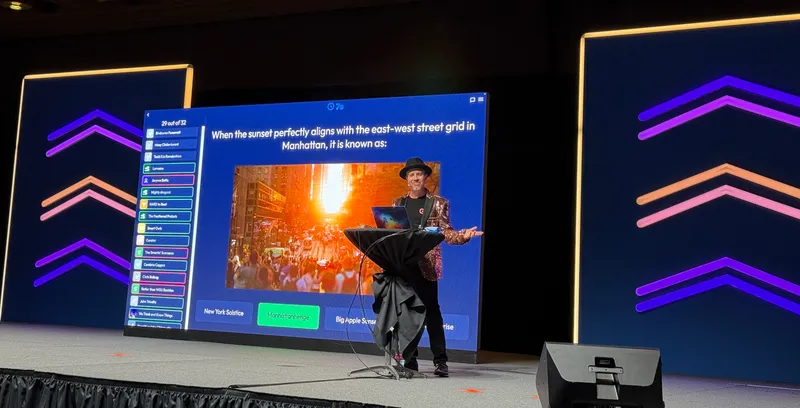
If everyone is seated for an opening or closing session, a hosted game show can give the room a common experience. The Go Game’s Break-the-Ice Game Show combines a networking Bingo round with a game show, while the Original Game Show is a shared group format. Confirm the stage, screens, microphones, seating, and transition into the next agenda item. A stage-based activity can generate energy, but it should not consume the only time attendees have for one-to-one conversation.
Between sessions: purposeful movement
A conference scavenger hunt can help people explore an event space and meet beyond their assigned table. The Go Game’s Conference Game is one option for this part of the agenda. Define where participants may go, which sessions are off-limits, when play stops, and how someone joins after the start. Give the venue and session leads the same route and timing information. The activity should complement the program rather than pull people away from talks they came to attend.
Reception or expo period: drop-in stations
At a reception, attendees enter and leave at different times. Game Stations offer a drop-in format that can start a conversation without requiring a synchronized kickoff. Place stations where people can see and reach them, but keep doorways, food service, and exhibitor aisles clear. Plan for short queues, a host who welcomes newcomers, and a way for someone to watch before joining. The game is the opening; leave room for the conversation afterward.
Design the room flow before the run of show is final
Walk the venue as an attendee would. Identify the first decision point after registration, the path to sessions, the sound level near each activity, and the places where a line might form. Put the invitation where people have a moment to notice it. If the format needs a screen or microphone, test sightlines and audio from the back and side of the room. If it needs movement, check accessibility, elevators, door thresholds, and areas that should remain quiet.
Give each activity a defined beginning, an easy way in, and a natural exit. A roaming game needs a visible check-in or instructions; a staged game needs a cue for when tables should turn back to the program; drop-in stations need a host who can explain the task in one breath. Plan for late arrivals and attendees who choose to observe.
Make participation welcoming without forcing it
Good networking prompts are specific enough to start a conversation but do not ask people to reveal personal, health, or employment information. Avoid instructions that require touching strangers, public self-disclosure, or performing alone on stage. Offer a seated or lower-sensory way to take part where practical, and make any phone requirement clear before the event. Ask the vendor how the activity works for attendees who cannot move quickly between rooms or who join after the opening.
If the event mixes colleagues, customers, and sponsors, make those roles visible and keep participation voluntary. Attendees should know whether a conversation is social, educational, or commercial. The aim is to make a genuine introduction easier, not to force a pitch.
Brief the producer on the details that change the format
Share the agenda and venue map before you settle the activity. Include expected attendance and arrival patterns, the length and location of the networking window, room layout, AV and Wi-Fi information, accessibility needs, staffing, and any restricted spaces. Tell the producer who can approve a timing change on site and which session must start on time.
Ask for a simple operating plan: who welcomes attendees, who explains the rules, how questions are handled, what happens if a session runs late, and how the activity ends. If you want custom prompts tied to the conference theme, agree on the final content and review it for clarity and privacy before event day.
Know what success would look like
Do not judge the activity only by applause or a busy photo. Decide in advance what you want to learn: Did first-time attendees find a way into conversations? Did people meet outside their usual teams? Could late arrivals join? Was the activity easy to understand? A short attendee question and observations from hosts may reveal more than a raw participation count. Treat these as signals for the next event, not proof that a game created lasting relationships.
A short vendor checklist
Before booking, ask: Which part of the agenda is this format built for? What space, staffing, screens, audio, or devices does it need? How do people join late or opt out? How will it work for attendees with different access needs? What is the plan if the program runs behind? What exactly can be tailored to our audience? The answers should be concrete enough to put into a run of show.
Frequently asked questions
What works for a short conference break?
Choose a format with a one-sentence instruction and no long opening. Guided introductions can work if attendees have enough time to talk; a drop-in station can work when arrivals are staggered. If the break is mostly transit, protect that time instead of trying to fit a full activity into it.
How do we avoid awkward networking games?
Give people a useful prompt, a choice about how to participate, and a reason to talk after the task. Avoid public pressure and questions that feel like a sales qualification. Test the instructions with someone who has not seen the plan.
Can one activity serve the whole conference?
Sometimes, but the arrival period, session room, and reception have different constraints. Choose a primary connection goal, then use a format suited to that moment. A planner can add a lighter touch elsewhere without turning every break into a game.
Choose a format that supports the conference
The best conference networking activity fits the schedule and helps attendees take the first step toward a useful conversation. Explore The Go Game’s conference experiences to compare formats, then share your agenda and venue details with the team to discuss what fits.